Start with an ordinary walk
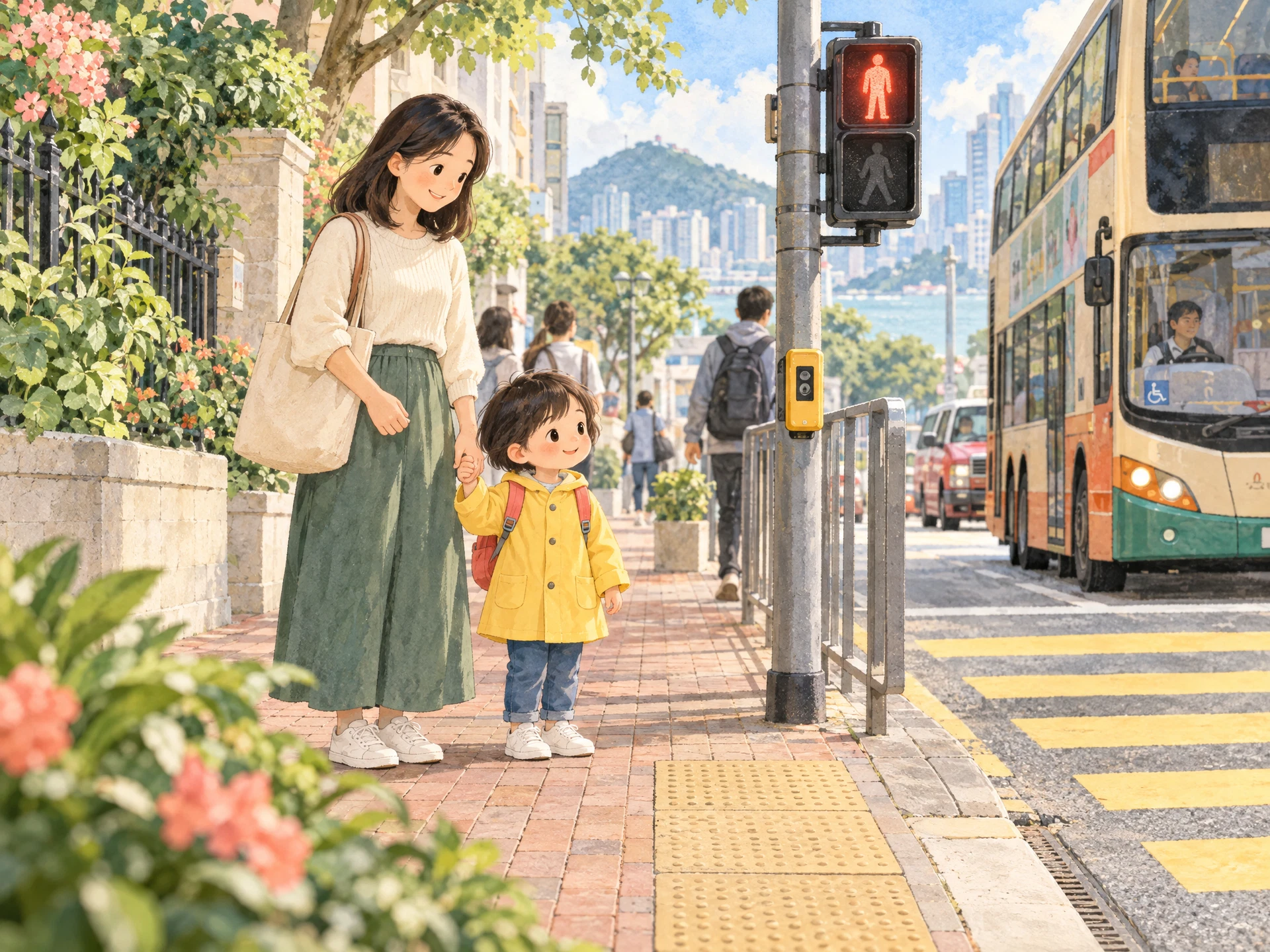
A trip to the bakery or kindergarten gives a road-safety story a familiar setting. Before leaving home, read about a character who pauses at the kerb with a grown-up. Ask your child to point to the pavement, crossing and waiting adult. The aim is to notice the scene together, not to rush through a list of rules.
Safe Kids Worldwide recommends adult accompaniment for children under ten and using crossings and traffic signals. A story is practice for a conversation; it is not permission for a young child to cross alone. A grown-up must still judge the real traffic conditions and stay with the child.
Use a short phrase you can repeat
Try “Stop, look, listen—and stay with me.” In the Hong Kong written-Chinese text, read: 「停一停,看清楚,聽一聽,與大人一起走。」 Use the phrase during pretend play first. Draw a pavement on paper, then let a toy character wait with a toy grown-up before crossing.
At a real crossing, put your phone away and model attentive waiting. Use a suitable pedestrian crossing and follow its signals while continuing to check traffic. A signal is not a substitute for looking, listening and an adult deciding that it is safe.
Choose the question for their age
For toddlers, point to one object and name it: “Red light.” For preschoolers, ask, “Where should our character wait?” For early-primary readers, compare two choices: rushing after a friend or pausing with the grown-up. Keep the discussion encouraging and grounded in what the child can see.
On the next read, let your child remember the familiar phrase. You can also invite them to describe a safe choice the character made. Repetition turns the book into a shared routine rather than a frightening warning.
Keep the lesson gentle
Praise the action rather than calling the child “good” or “bad”: “You waited beside me and looked carefully.” If a child is distracted, guide them calmly back to the safe waiting place. Avoid testing safety beside moving traffic.
SparkPageKids’s Look, Listen, Cross! sample lets you explore this topic in English and Hong Kong written Chinese, displayed separately or together, with a page-by-page parent guide. Adult supervision remains essential outside the story.
Further reading
These family activities are suggestions, not a substitute for professional advice or adult supervision. Sources supporting the shared-reading and safety guidance:
Make your child the hero.
Choose the topic and reading level, then try a cover plus first story-page sample in English and Hong Kong written Chinese together.
Build this kind of story ↗